
Hyperloop explained
Hyperloop brings airplane speeds to ground level, safely. Passengers and cargo capsules will hover through a network of low-pressure tubes between cities and transforming travel time from hours to minutes.

Capsule
28-40
Passengers/capsule
160,000+
Passengers daily
4,000
Cargo shipments daily

BATTERY
- High energy and power density
- Low thermal footprint

AUGMENTED WINDOWS
- Enhanced experience
- Fuse comfort and entertainment

PASSIVE MAGLEV
- Electromagnetic propulsion
- Passive magnetic levitation
At HyperloopTT we innovate for better and smarter travel experiences. Passengers and goods will travel in pressurized capsules floating on a frictionless magnetic cushion within the tubes. Capsules are powered by a linear induction motor, an electromagnetic propulsion, and embedded rechargeable batteries. As a result, the system is silent and emission-free.
The capsules are engineered and designed to create a safe and harmonious environment for the passengers, with customized interior for use-based experiences. Each capsule is 30 meters in length and can carry 28 to 40 passengers. Our system is designed for capsule departures every forty seconds and a maximum speed of 1,223 km/h. the system is capable of moving 164,000 passengers a day on one line at full efficiency.
HyperloopTT’s technology breakthrough is a next generation passive magnetic levitation system. It’s called Inductrack. Magnets arranged in a Halbach array configuration enable passive levitation over an unpowered but conductive track. And as capsules move through the low pressure environment, they use very little energy on route thanks to the reduced drag forces. The Inductrack system was tested and validated on a full-scale passive levitation track. HyperloopTT improved the technology and optimized it for a low pressure environment through testing in the prototype.
In addition, HyperloopTT has developed a new skin material for capsule safety called Vibranium™. Using carbon-fiber and embedded sensors, this new smart material is eight times stronger than aluminum and ten times stronger than steel alternatives, and transmits critical information regarding temperature, stability, integrity and more, wirelessly and instantly. It is also much lighter in weight—roughly five times less than steel and 1.5 times less than aluminum—reducing energy output to propel the capsule.

Structure
TUBES
- Steel/concrete/carbon fiber
- Elimination of friction
- Protection from weather and traffic crossing
VACUUM
- Low-pressure environment
- Increased efficiency
- Joint development with the market leader Leybold
PYLONS
- Reinforced concrete
- Structural health monitoring
- Seismic isolation bearings
- Height variance for terrain
- Potential energy storage
HyperloopTT builds its system around reducing friction and increasing efficiency.
Hyperloop system consists of large tubes that will primarily be built on pylons, with some ground level and underground segments as needed. The elevated system results in lower the cost of land acquisition, makes it impervious to weather conditions, resilient to earthquakes, eliminates the possibility of collision with road traffic, and will provide eco-opportunities.
Hyperloop replicates high altitudes in a low pressure environment inside the tube system by removing most of the air with vacuum pumps, which drastically reduces the drag forces.
In addition, it is automated with advanced technologies that only require monitoring from humans. Automation improves efficiency and reliability by enabling system elements to be in constant communication with each other and with operation control centers for near real-time response plans.
In partnership with MAD architects, the design combined with self-sustaining energy strategies results in lower construction and operational costs, translating into a profitable system with low ticket price projections. Utilizing a combination of existing and new technologies, the Hyperloop system will be both high-speed and resource-efficient, with a safe and comfortable experience for passengers and cargo.

Station

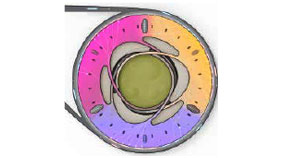
DEWDROP
- Hyperloop terminal station prototype
- Circular guidance and Operating System
PLATFORM
- 3,600 passengers per hour
- Every gate will manage 180 people per hour

INTEGRATION
- Easily built into the existing infrastructure
- Convenient to build within the city
HyperloopTT reinvents transportation at every stage of the process. We implement intermodal solutions into our design to make our station accessible and leverage technology to create an entirely new passenger experience.
As part of the journey, the station has a crucial impact on the passenger. HyperloopTT and design firm AN.ONYMOUS created a next generation station design to integrate transit with the local environment.
The HyperloopTT station is also energy-efficient, creating a transit hub for the community and most importantly an urban center. The dynamic uses of space include places where passengers can go to access services, experiences, and goods while other spaces are devoted to enhancing passengers’ psychological experience.
NOW PLAYING A HYPERLOOP TEST:

 Around The WORLD.......